

It’s easy to get lost between ‘eco’ promises, ‘responsible’ claims and logos on product sheets. However, reading labels and certifications carefully can help you make more secure purchases, align your choices with your commitments and avoid misinterpretation.
In this article, you will learn how to understand what each mark guarantees (and does not guarantee), and then how to choose the right selection criteria on TH4.com.
Large families: « What do I want to guarantee?
Before looking for « the best label », clarify your objective. In practice, you can’t guarantee the same thing if you’re talking about chemical substances, organic fibres, recycled content, working conditions or origin.
Health / chemical substances

| Reference | Category | Perimeter | General significance |
|---|---|---|---|
| OEKO-TEX® 100 (STANDARD 100) | Product certification (tests) | Finished product / tested components | Attests that the components of the product have been tested to ensure the absence of a list of harmful chemical substances. (Please note: this does not guarantee the organic nature of the fibre or the social conditions under which it was manufactured). |
| EU Ecolabel (European Ecolabel) | Type I environmental certification (public/competent third party) | Product (textile category): multi-impact criteria | Indicates that the product meets strict environmental criteria covering its entire life cycle (extraction of materials, production, end of life). |
Remember: if your priority is chemical safety (skin contact, children, daily use), these are useful benchmarks. But this alone does not tell you whether the fibre is organic or recycled.
Biological materials (‘organic’ fibres)
| Reference | Category | Perimeter | General significance |
|---|---|---|---|
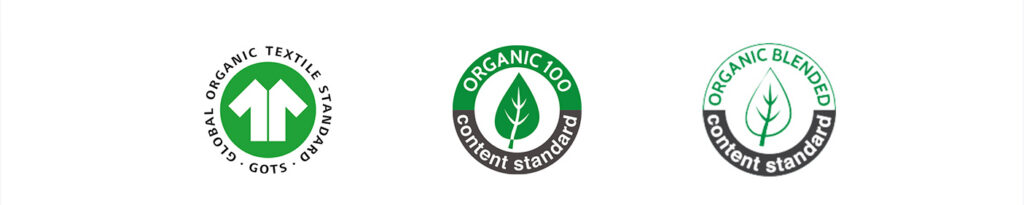
| G.O.T.S. (GOTS) | Certification (product + supply chain) | Organic fibres + processes + social criteria + traceability | Guarantees the use of a majority of organic fibres and imposes strict environmental and social criteria, with traceability throughout the textile production chain. |
| O.C.S. 100 (OCS 100) | Certification (traceability of organic materials) | Traceability of organic content in the chain | Guarantees the presence and traceability of at least 95% certified organic materials in the product. |
| OCS Blended | Certification (traceability) | Mixing: organic part traced | Guarantees the presence and traceability of a defined proportion of organic materials mixed with other non-organic fibres. |
Recycled materials
| Reference | Category | Perimeter | General significance |
|---|---|---|---|
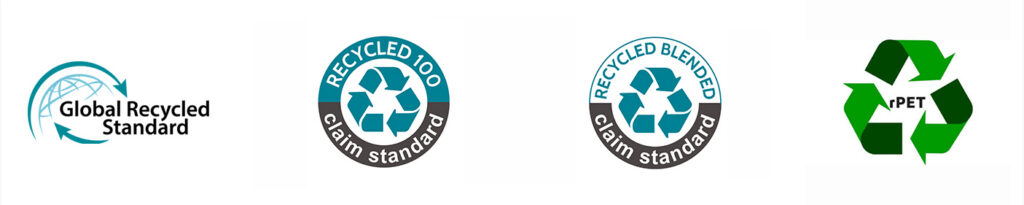
| G.R.S. (GRS) | Certification (product + supply chain) | Recycled content + traceability + social/environmental/chemical requirements | Validates the percentage of recycled fibre, while requiring compliance with environmental, social and chemical criteria throughout the supply chain. |
| R.C.S. 100 (RCS 100) | Certification (recycled traceability) | Traced recycled content (high %) | Guarantees the traceability of the vast majority of recycled materials used in the product. |
| R.C.S. Mixed (RCS Blended) | Certification (traceability) | Mixing: recycled part traced | Guarantees the traceability of a defined proportion of recycled materials, mixed with other fibres. |
| Recycled PET (rPET) | Material information (may or may not be certified) | Material | Indicates that the raw material comes from recycled PET plastic (ideally requiring third-party certification such as GRS or RCS to guarantee exact traceability). |
Mistake to avoid: confusing « recycled material » with « certified product ». A textile can be advertised as rPET without the traceability being formalised to the same level as a GRS/RCS type certification.
Manufacturing and social conditions
| Reference | Category | Perimeter | General significance |
|---|---|---|---|
| Fair Wear | Programme/initiative (brands) + checks/audits | Brand level + factories monitored | Indicates that the brand actively participates in a process of continuous improvement of working conditions in its partner factories (this is a brand commitment, not a product certification). |
| Fairtrade | Certification (fair trade) | Material/ingredient (e.g. cotton) + chain | Certifies that the raw material (such as cotton) has been purchased in accordance with Fairtrade standards, guaranteeing producers a fair price. |
| W.R.A.P. | Site certification (social / compliance) | Factory / production site | Validates the social and ethical compliance of a specific production site following a factory audit. |
| Amfori BSCI | Social audit (audit programme) | Plant / site | Proves that a social audit has been carried out in the factory in accordance with a code of conduct designed to improve working conditions. |
| Sedex | Platform / database (not certification) | Sharing supplier information + audits | Indicates that the supplier has joined this global platform to share its social and ethical audit data transparently. |
Vegan / animal-free

| Reference | Category | Perimeter | General significance |
|---|---|---|---|
| PETA (PETA-Approved Vegan) | Brand label/programme (rather declarative, depending on the dossier) | Product / collection / brand | Ensures (usually on a declarative basis by the brand) that the composition of the product is free from materials of animal origin. |
| EVE Vegan | Vegan certification / label (third party) | Product (composition) | Guaranteed by an independent third-party organisation that the composition of the product contains no components of animal origin. |
A word of caution: « vegan » does not automatically mean « low impact » (materials, dyes, durability). That’s a different criterion.
French origin

| Reference | Category | Perimeter | General significance |
|---|---|---|---|
| O.F.G. (Origine France Garantie) | Certification of origin (certification mark) | Product (calculation of origin / added value + place of manufacture) | Attests that the product takes its essential characteristics in France and that a majority of its cost price is acquired there. |
Field tip: If you’re looking for « Made in France » benchmarks, there are several approaches depending on the sector. The article« The rise of Made in France personalised textiles » provides more detailed information on French standards and labels.
What labels don’t (often) say: grey areas
Even with good reference points, there are areas where we are quick to over-interpret.
« Certified » does not mean « 100% of the product ».
Certification can cover :
- a material (e.g. fibre),
- a component (e.g. fabric, not accessories),
- a complete product,
- a factory,
- or a process.
« Eco » is not a standard
The terms « eco », « responsible » and « sustainable » are sometimes marketing claims. They may be sincere… but they must be linked to proof (certification, traceability, technical data sheet).
Express checklist (and mistakes to avoid)
Your main need → useful benchmarks
| Need | Label, certificate, audit |
|---|---|
| Organic material | GOTS, OCS |
| Recycled material + traceability | GRS, RCS |
| Controlled substances | OEKO-TEX® STANDARD 100, EU Ecolabel |
| Social / working conditions | Fair Wear, WRAP, amfori BSCI, Sedex |
| Vegan | PETA-Approved Vegan, EVE Vegan |
| French origin | OFG |
Mistakes to avoid
Confusing a factory audit with product certification
Thinking that a « material » label automatically covers the supply chain
Choosing a « certified » product without checking the scope (material, accessory, complete product)
⚠️ Warning: Personalising a product (embroidery, screen printing, transfer) may invalidate its product certification (such as GOTS or OEKO-TEX) if the marking workshop and the inks themselves do not have the required certification.
How to use TH4 filters intelligently
To save time, the idea is not to pile on all the labels, but to filter according to your real objective.
What is your « non-negotiable » need?
E.g.: « recycled traced », or « organic », or « French origin », or « skin contact ».
Select the appropriate filters
E.g.: « GOTS », « GRS », « PETA »…
Add one or more quality/use criteria
E.g.: weight, cut, strength, type of material, use (event, endowment, standardisation, gift).
On TH4, filters by label, composition or grammage are designed to facilitate and speed up your technical searches. These filters remain pre-selection tools. Always make sure you confirm your final choice by carefully consulting the product sheets. To get started, you can explore the range directly on th4.com and then refine it using the filters according to your priorities.
Good to know: Some brands, such as Neutral and Native Spirit, place labels at the heart of their strategy and offer a large number of labelled products. In all cases, remember to ask yourself: « What exactly is certified?
💡 Professional advice for your demanding projects and strict specifications
This article aims to simplify your day-to-day work and quickly guide you towards the right choices. However, given that compliance requirements call for absolute legal precision, please bear in mind that this guide remains a popularisation tool.
To ensure that your recommendations to your customers are totally secure, adopt these 3 reflexes:
–> Always validate compliance by consulting the product’s detailed technical data sheet or transaction certificates if required.
–> Make sure you know the specifics of each label class (e.g. OEKO-TEX baby class vs. adult class).
–> Don’t forget the impact of personalisation, as the addition of non-certified marking (embroidery, inks) can alter the certification of the virgin product.
Conclusion
Reading labels and certifications properly means avoiding shortcuts: a logo can be an excellent benchmark… as long as you understand what it covers (product, material, factory, brand) and what it does not cover (marking, accessories, social perimeter, etc.).
To go faster, always start with your objective (« I want to guarantee what? »), then use the TH4 filters to build a coherent selection.